If you’ve ever watched a room full of three- and four-year-olds transform the moment you start a clapping song — settling down, locking eyes with you, suddenly with you instead of scattered in six directions — you already know something science is only now catching up to: music isn’t a break from learning. It is learning.
A 2023 literature review published in Brain, Behavior, & Immunity – Health by researchers Muriel Zaatar and colleagues pulled together decades of neuroscience research to answer a simple question: what does music actually do to the brain? Their conclusion, in a word, is transformative. Music, they found, has a remarkable capacity to reshape neural networks and drive neuroplasticity — the brain’s ability to adapt, rewire, and grow in response to experience. And critically, the researchers note that music’s influence begins even before birth and continues to shape development throughout early childhood.
For Pre-K teachers, that’s not just an interesting fact. It’s a validation of everything your intuition already tells you every time you reach for a song instead of a worksheet.
Three Things the Research Points To (That Every Pre-K Teacher Can Use)
1. Music sharpens attention, memory, and learning
The review highlights music’s positive effects on cognition — memory, attention, and learning — describing it as a genuine cognitive enhancer, not just a pleasant accompaniment to the school day. For a Pre-K classroom, where attention spans are short and executive function is still under construction, this matters enormously. A well-placed song can be the difference between a transition that dissolves into chaos and one that flows smoothly into the next activity.
In practice: Repetitive, melodic routines — a clean-up song, a circle-time hello song, a counting song — aren’t filler. They’re scaffolding little brains can hold onto.
2. Music regulates emotions
According to the review, music profoundly affects emotional states and offers real therapeutic value in easing stress and anxiety. Anyone who has calmed a tearful child at drop-off with a familiar tune, or used a quiet melody to ease a class down from recess, has seen this firsthand. Music gives children — who often don’t yet have the words for what they’re feeling — a way to regulate and express emotion nonverbally.
In practice: A gentle song at nap time or during a hard goodbye isn’t a nice-to-have. It’s an emotional regulation tool with research behind it.
3. Music’s benefits reach well beyond the “music corner”
Perhaps the most striking takeaway from the review is how far music’s reach extends — into physical coordination, social bonding, and language development, in addition to cognitive and emotional growth. The researchers describe music as engaging a wide network of brain regions all at once: sensory-motor areas, memory circuits, and emotional processing centers, working together rather than in isolation.
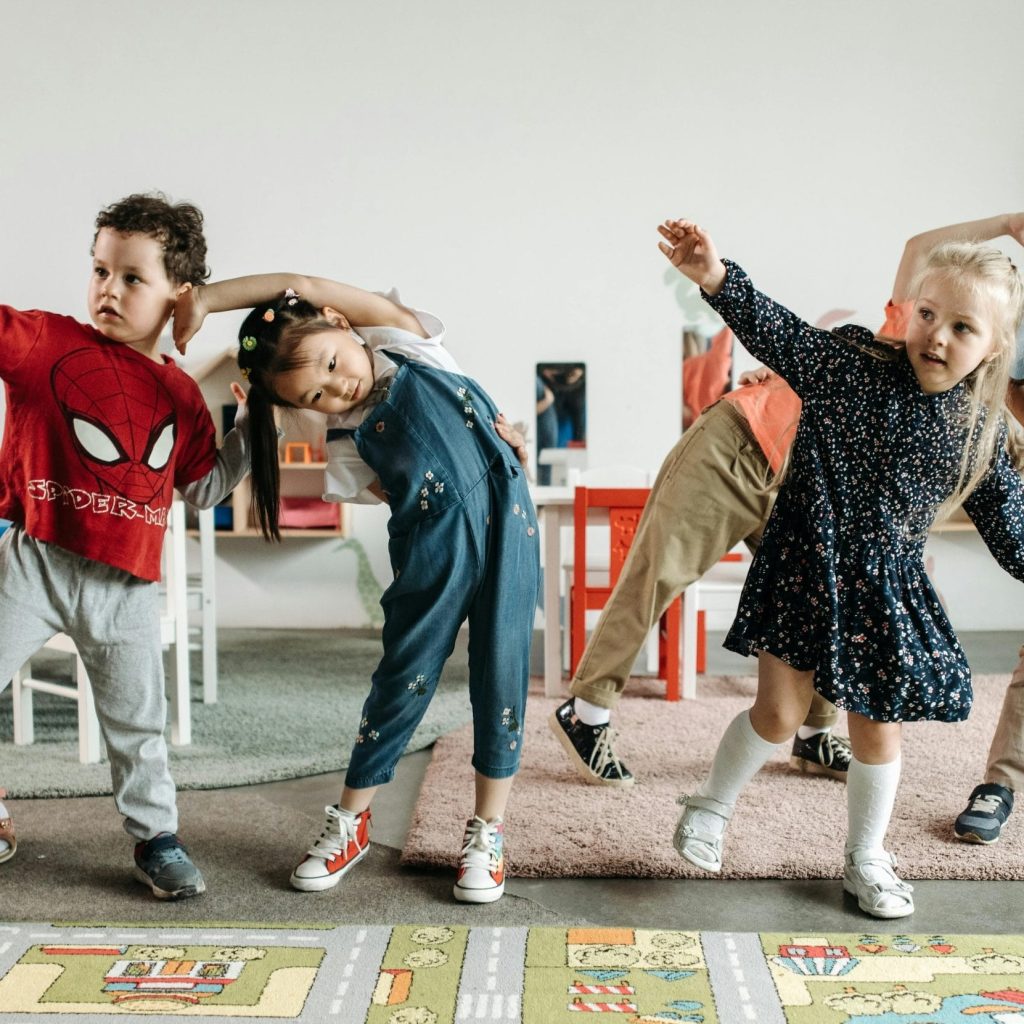
That’s a powerful reminder for early childhood educators: singing, moving to a beat, and playing simple instruments together aren’t separate from language, math, and social-emotional goals. They’re often the fastest route to them.
What This Means for Your Classroom
None of this requires a music degree or an elaborate curriculum overhaul. The research is clear that consistent, joyful, age-appropriate musical experiences — sung routines, rhythm games, movement to music — are what drive these developmental benefits. Simplicity and repetition are strengths here, not shortcomings.
This is exactly the space where a resource like Songbird Musicals can make a Pre-K teacher’s day easier. Rather than hunting down songs, planning musical transitions from scratch, or trying to remember the words to a hello song at 7:45 AM, Songbird Musicals gives teachers ready-made, developmentally appropriate songs and musical activities designed specifically for early childhood classrooms — the kind of consistent, engaging musical routines the research suggests are doing real work in children’s growing brains. It’s less about adding one more thing to your plate and more about making the music you’re probably already reaching for a little easier to bring into the room, every single day.
The Takeaway
You don’t need a peer-reviewed journal to tell you that music makes your classroom better — you feel it every day. But it’s worth knowing that the neuroscience agrees: those songs you sing before snack time, the clapping games, the goodbye tune at pickup — they’re quietly, measurably shaping the brains in front of you. Keep singing. The research says it matters more than you might have realized.
Source: Zaatar, M. T., Alhakim, K., Enayeh, M., & Tamer, R. (2023). The transformative power of music: Insights into neuroplasticity, health, and disease. Brain, Behavior, & Immunity – Health, 35, 100716.